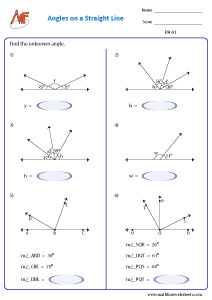
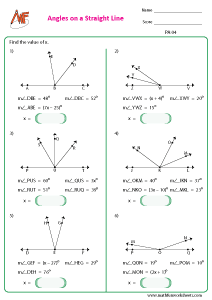
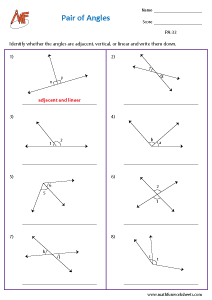
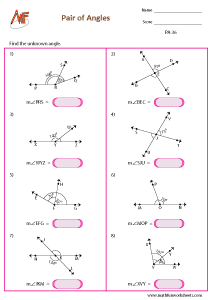
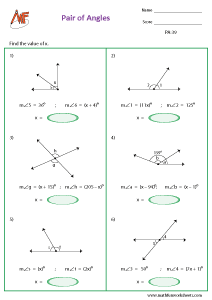
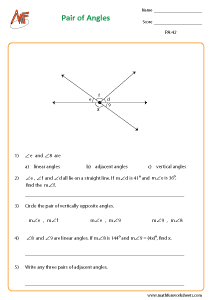
Pair of angles worksheets help students identify and solve angle relationships in geometry. These free printable worksheets PDF with answers cover adjacent angles, vertical angles, linear pairs, angles on a straight line, and missing angle problems for Grades 6–8.
To begin with, complementary angles are two angles whose measures add up to 90 degrees. They often appear in right-angle triangles or when a right angle is divided into two smaller angles. On the other hand, supplementary angles are two angles whose sum is 180 degrees. These usually occur when two lines form a straight angle or a linear pair.
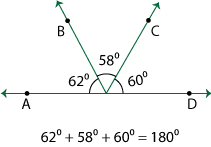
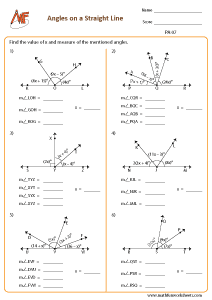
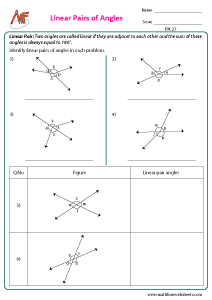
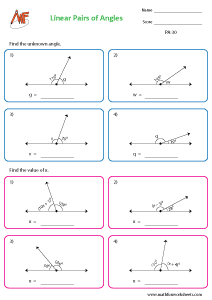
Now, we will learn more pairs of angles for grade 6 to grade 8 like linear, vertically opposite and adjacent angles here. Before you know all these pairs of angles there is another important concept which is called ‘angles on a straight line’. The sum of angles on a straight line is 180 degree. Thus, any number of angles on a straight line amounts to 180 degree.
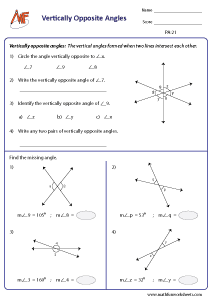
Vertically opposite angles:
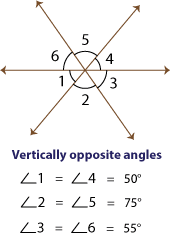
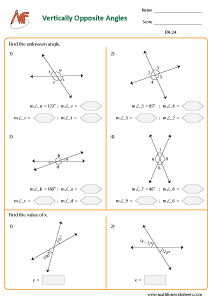
Vertical angles or vertically opposite angles are opposite angles formed when two lines intersect each other. Thus, two pairs of opposite angles are formed when two lines intersect. Here, the pair of opposite angles are equal. Refer the figure given below for clear understanding.
Adjacent angles:
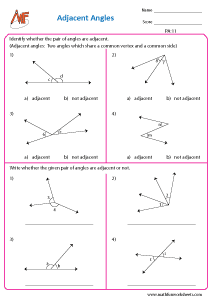
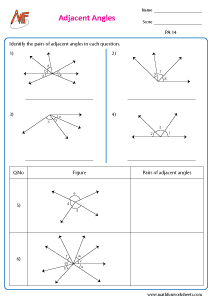
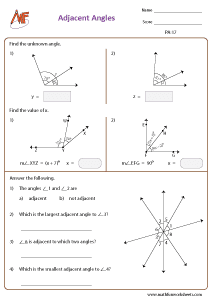
Two angles are said to be adjacent, if they have a common vertex and a common arm. The angles should not overlap which means the other arms are lying on the opposite side of the common arm.
Furthermore, adjacent angles share a common side and vertex but do not overlap. They are positioned side-by-side, and understanding them is essential when analyzing geometric shapes and solving problems involving parallel lines and transversals. In contrast, vertically opposite angles are formed when two lines intersect, creating two pairs of opposite angles that are always equal. This property is extremely useful in proving geometric theorems and solving for unknown angles.
Moreover, recognizing these angle relationships allows students and professionals to simplify complex diagrams and solve mathematical problems more efficiently. It also builds a strong foundation for more advanced topics in geometry and trigonometry. For instance, when working with polygons, knowing how angle pairs behave can help in calculating missing angle values and verifying the accuracy of constructions. Therefore, understanding pairs of angles is not only a key skill in academics but also a practical tool in fields such as engineering, architecture, and design.
By mastering these basic relationships, learners can confidently progress to more complex geometric concepts and real-world applications.