Search

Browse by Topics

Complementary and Supplementary Angles Worksheets

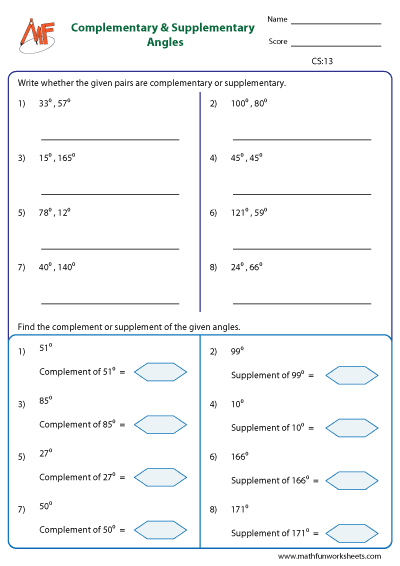
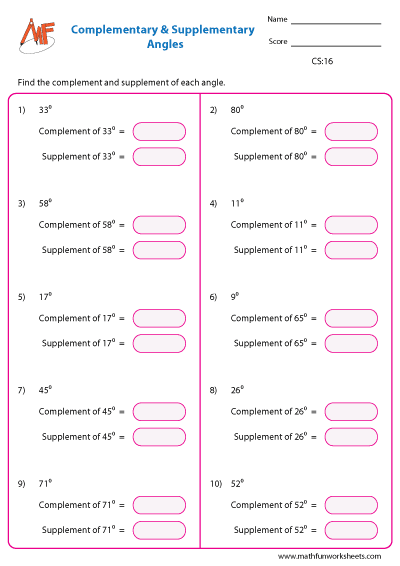
Complementary and Supplementary Angles are basic concepts in geometry. These angles help students understand how angles relate to each other. Complementary angles are two angles whose measures add up to 90 degrees. For example, if one angle is 40°, the other must be 50° to be complementary. Supplementary angles, on the other hand, are two angles whose sum is 180 degrees. If one angle measures 110°, the other must be 70° to complete the pair.

Problems on complementary and supplementary angles are most easy to solve if you just remember the numbers 90 and 180. With the definitions given below, you will know how these numbers have been used in angles. You have ample problems to identify and calculate the missing measure of angles. Linear equations are also involved to calculate the measure of angles.

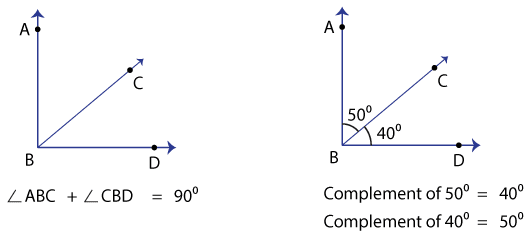
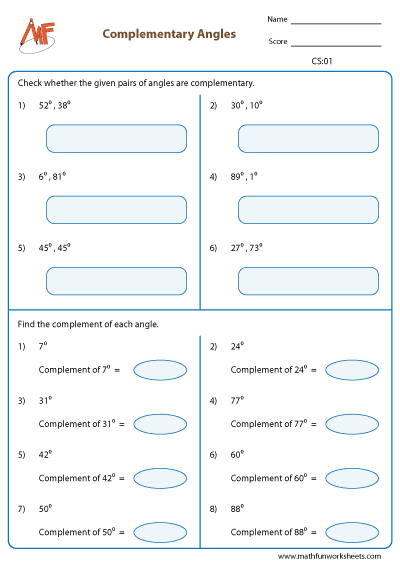
Complementary angles are two angles whose sum is 90°. So, the complement of 50° is (90 – 50), that is 40°. The complement of 40° is just the reverse, which is 50°.

Complementary Angles

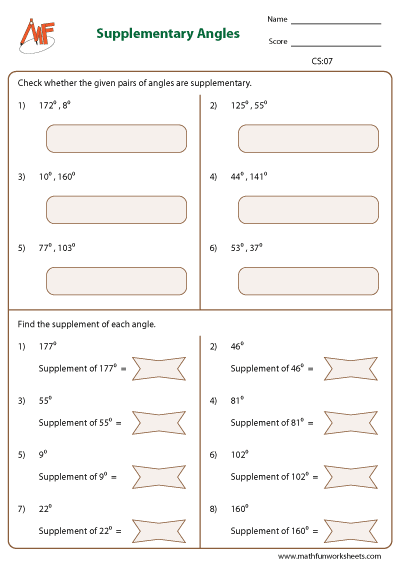
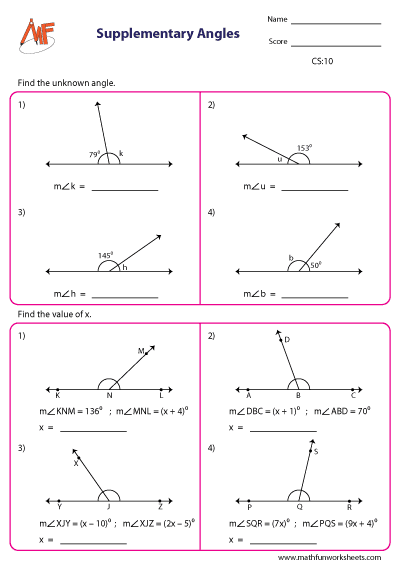
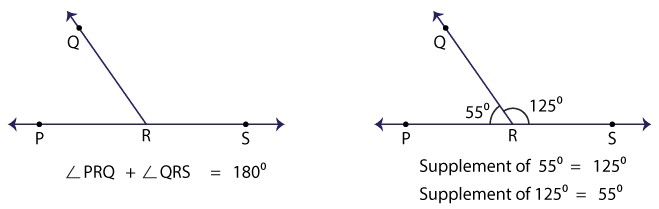
Supplementary angles are two angles whose sum is 180°. It can also be called linear pair of angles. The sum of a pair of linear angles is always 180°. Thus, the supplement of 55° is (180 – 55), that is 125°. The supplement of 125° is 55°, the vice versa.

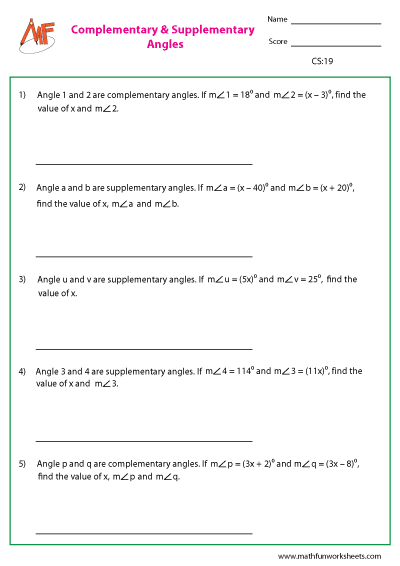
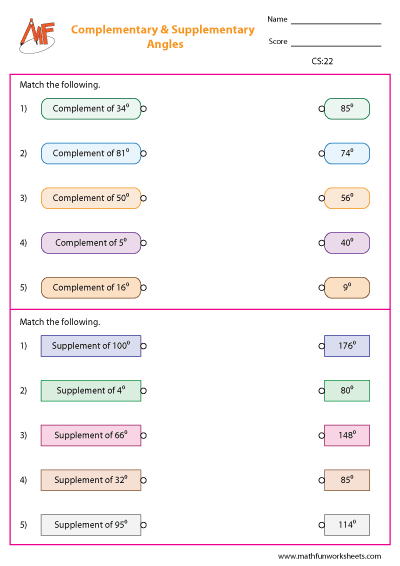
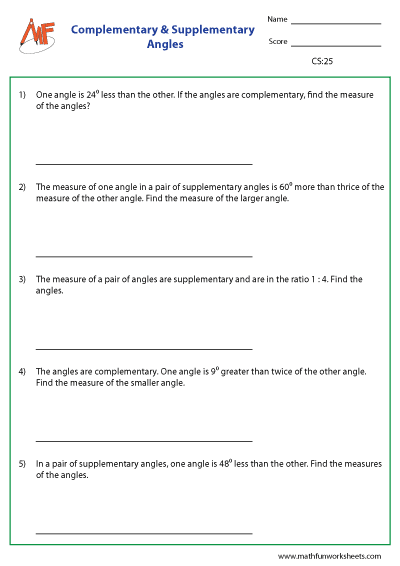
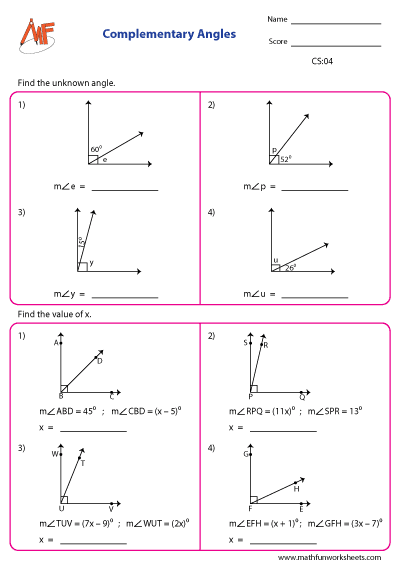
Supplementary AnglesThe first few worksheets would deal with the basics. Then, to find missing angles. In the end, three exclusive worksheets have 5 word problems in each sheet. All you need to do is to form equations and solve for the unknown variable to find the measure of angles. All the best practice materials are available here for free download. Print them at once!
Complementary and Supplementary Angles

To easily remember the difference, think of the letter C in complementary as standing for a corner (90°). Similarly, the S in supplementary can remind you of a straight line (180°).

These angle types appear often in geometry problems. For instance, when two angles form a right angle, they are complementary. When two angles lie on a straight line, they are supplementary. These relationships are useful when solving problems that involve parallel lines, triangles, or polygons.
Before solving complementary and supplementary angles worksheets, students should understand types of angles, measuring angles with a protractor, and pair of angles relationships. Practice these skills with our related geometry worksheets.

Download all complementary and supplementary angles worksheets PDF with answers and practice finding complements, supplements, missing angles, equations, and real-world geometry problems. These free printable worksheets help students master angle relationships with confidence.

Related Angles Worksheets

Frequently Asked Questions

Complementary angles are two angles whose measures add up to 90°.

Supplementary angles are two angles whose measures add up to 180°.

Subtract the angle measure from 90°.

Subtract the angle measure from 180°.

Yes, all worksheets include answer keys.

Scroll to Top