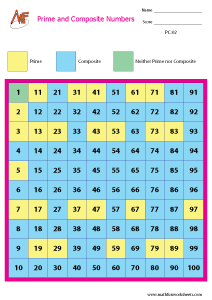
Prime and composite numbers worksheets help students identify, classify, and compare numbers through engaging printable PDF activities. These free worksheets include prime number identification, composite number classification, factor-based exercises, and mixed practice with answers for grades 4–6.
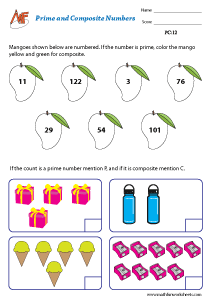
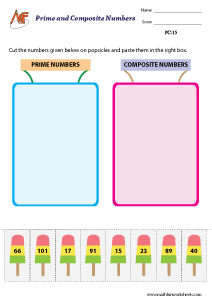
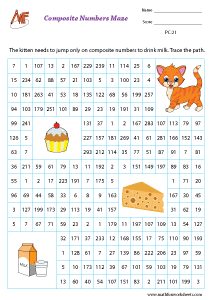
Here are more than 25 prime and composite number worksheets, carefully designed for grade 4 through grade 6 students. We will clearly discuss the concepts of prime, composite, co-prime, and twin prime numbers. We can classify all natural numbers as prime and composite.
Prime Numbers:
Any natural number that has only two factors, the number itself and 1 is known as a prime number.
Eg. 1, 2, 3, 5,……11,……23,…..97,…
The number 3 has only two factors. That is, it is only divisible by 3 and 1. (Without leaving a remainder). Thus 3 is a prime number.
The number 2 is the smallest prime number. Interestingly, its the only even prime number which means all other prime numbers are odd.
Composite Numbers:
Any natural number that can be divided by other natural numbers and with the number itself and 1 is a composite number.
Eg. 6, 8, 9,…..86,…99,…
With 1 and 6, the number 6 has other factors like 2 and 3. Thus the factors of 6 are 1, 2, 3, and 6 which makes 6 a composite number.
1 is the only number which is neither prime nor composite.
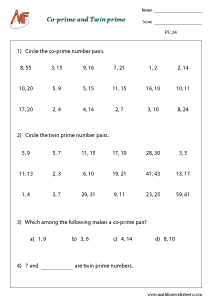
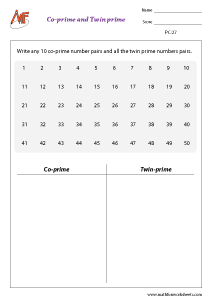
Twin primes: Prime number pairs which differ from each other by 2 are twin primes. Eg. 3 and 5, 11 and 13, 41 and 43…..
In the above shown pair of numbers, the difference between the numbers is 2.
Co-primes: Numbers that do not have any common factor other than 1 are called co-prime numbers. Eg. Number pairs 2 and 3, 3 and 4, 4 and 5…………17 and 23, 29 and 31,……..
29 and 31 are both twin primes and co-primes.
All twin primes are prime numbers, whereas all co-primes need not be prime numbers.
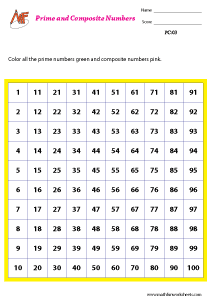
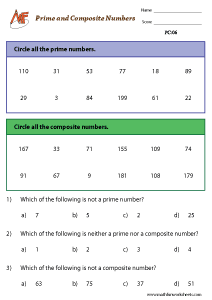
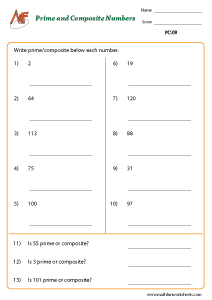

Students can strengthen related skills with our factors worksheets, divisibility rules worksheets, and prime factorization worksheets.
Prime numbers have exactly two factors, while composite numbers have more than two factors.
No, 1 is neither a prime nor a composite number.
These worksheets are suitable for grades 4–6.
Yes, the printable PDFs include answer keys.
Students can list factors or use divisibility rules and the Sieve of Eratosthenes.
Copyright © 2026 – Math Fun Worksheets