Search

Algebra

Trigonometric Charts

Home Algebra Trigonometric Charts Trigonometric Charts Trigonometric Charts play a vital role in mathematics, especially in the study of angles and measurements. These charts provide the values of trigonometric functions such as sine, cosine, and tangent for various angles. Typically, students begin using them around the middle school level, particularly in grade 9. They serve as a quick reference tool and help simplify complex calculations. As a result, students can save time and improve accuracy during problem-solving. Understanding trigonometry is crucial in mathematics, physics, engineering, and various competitive exams. This webpage provides the standard values of trigonometric functions like sine (sin), cosine (cos), tangent (tan), and their reciprocals — cosecant (csc), secant (sec), and cotangent (cot) — for commonly used angles. Moreover, these charts are not limited to academic use. Engineers, architects, and scientists use them in practical applications. For example, they aid in designing buildings, analyzing waves, and calculating distances. Therefore, learning how to read and apply these charts early in your education is highly beneficial. It builds a strong foundation for more advanced studies in trigonometry and related fields. Related Worksheets: Trigonometric Ratio Worksheets Download Free Trigonometric Charts In addition to their practical use, these charts enhance learning by helping students recognize patterns and relationships between angles and ratios. This leads to better comprehension and improved grades. Students who practice regularly with these charts often gain confidence and perform better in exams. Besides, the charts are easy to memorize and use, which makes them a helpful tool during tests and assignments. In conclusion, mastering these charts at an early grade level equips students with the skills needed for higher-level math and real-world applications. They are simple, effective, and essential. So, if you’re in grade school and aiming for academic success, start using trigonometric charts today. With consistent practice, you’ll see a noticeable improvement in both your understanding and performance. Keep learning, keep practicing, and watch your grades rise.
Quadrants Worksheets

Home Algebra Quadrants Worksheets Quadrants Worksheets Learning to navigate the coordinate plane becomes easier and more engaging with quadrants worksheets. These worksheets help students understand how to plot points, identify locations, and work with positive and negative values in all four quadrants. By practicing regularly, learners build a solid foundation in graphing, geometry, and algebra. To start, it’s essential to teach students how the coordinate plane is divided into four quadrants. Each quadrant represents a different combination of positive and negative x and y values. Understanding these combinations helps students correctly place points and interpret data. Moreover, working with angles in the coordinate plane adds an exciting layer of complexity. Introduce the concept of angles formed from the origin and how they move counterclockwise. Students can learn to measure these angles in both degrees and radians, connecting geometry with trigonometry. For example, a 90-degree angle lies on the boundary between Quadrant I and II, while a 180-degree angle takes you to Quadrant III. This connection strengthens spatial awareness and prepares students for more advanced math. Additionally, practice problems can ask students to determine the correct quadrant for a given angle or point. These exercises improve reasoning and critical thinking. By including real-world scenarios—like navigation or engineering applications—you make the content meaningful and relatable. Quadrants Worksheets free download pdf To keep learning dynamic, offer a variety of worksheet formats, such as fill-in-the-blank charts, graph plotting tasks, and angle identification drills. Some worksheets may even include puzzles or games to boost engagement. With consistent use of these tools, students will confidently navigate the coordinate plane and understand the significance of each quadrant. Help them master graphing, angle placement, and measurement with fun, clear, and challenging worksheets designed to build lasting math skills.  

Roots of Quadratic Equation

Home Algebra Equations Roots of Quadratic Equation Roots of Quadratic Equation Worksheets Roots of quadratic equation worksheets help students practice solving quadratic equations through various methods. These worksheets provide step-by-step problems that build a strong understanding of how to find the roots of any quadratic equation. With regular practice, students gain confidence and accuracy in solving equations. To begin, the worksheets introduce the standard form of a quadratic equation: ax² + bx + c = 0. Students first learn how to identify the coefficients a, b, and c. Then, they apply different methods such as factoring, completing the square, and using the quadratic formula. Factoring is often the easiest method for simple equations. For example, students factor x² + 5x + 6 = 0 into (x + 2)(x + 3) = 0 and solve for the roots x = -2 and x = -3. Next, they try completing the square for equations that are not easily factorable. This helps them understand how to manipulate equations step by step. Moreover, students use the quadratic formula to solve any quadratic equation. Worksheets guide them through plugging values into the formula:x = (-b ± √(b² – 4ac)) / 2aThey learn how to simplify the square root and interpret the result. Roots of Quadratic Equation worksheets free download pdf In addition, many worksheets include problems on identifying the nature of roots using the discriminant. Students analyze whether the roots are real, equal, or complex based on the value of b² – 4ac. These worksheets are perfect for classroom use or at-home practice. They suit all learning levels, from beginners to advanced learners. In conclusion, these worksheets help students master an essential algebra skill. They improve problem-solving abilities and prepare students for higher-level math topics. Use them to build a strong mathematical foundation.

Solving Quadratic Equation Worksheets

Home Algebra Equations Solving Quadratic Equation Solving Quadratic Equation Worksheets Solving quadratic equation worksheets provide students with structured practice in solving quadratic equations using different methods. These worksheets help learners build a strong foundation in algebra by working through step-by-step problems. With regular use, students gain confidence in tackling quadratic equations efficiently and accurately. To begin, students review the standard form of a quadratic equation: ax² + bx + c = 0. The worksheets guide them to identify the coefficients and select the best method to solve the equation. Common methods include factoring, completing the square, and using the quadratic formula. Factoring is often introduced first. For example, students solve equations like x² – 7x + 10 = 0 by rewriting it as (x – 2)(x – 5) = 0. Then, they find the roots x = 2 and x = 5. This method is quick and easy when the equation is factorable. Next, students practice completing the square. This technique is useful for more complex equations and helps students understand how to manipulate expressions carefully. Worksheets break this process into simple, clear steps to avoid confusion. Then, learners use the quadratic formula:x = (-b ± √(b² – 4ac)) / 2a.This formula works for all types of quadratic equations. Students substitute values and solve, learning how to simplify square roots and handle both real and complex solutions. Solving Quadratic Equation worksheets free download pdf In addition, some worksheets include word problems. These tasks connect math to real-world situations, helping students see the value of what they’re learning. They also practice identifying the correct method based on the problem’s structure. In conclusion, these worksheets are essential tools for mastering algebra. They improve problem-solving skills and prepare students for advanced math courses. These worksheets are perfect for classwork, homework, or independent study.

Multi Step Equation Worksheets

Home Algebra Equations Multi-Step Equation Multi-Step Equation Worksheets Multi step equation worksheets help students build strong algebra skills by solving equations that require more than one operation. These worksheets guide learners through solving problems with variables, fractions, parentheses, and both sides of the equation. With consistent practice, students develop accuracy, speed, and confidence in solving algebraic equations. To begin, students review basic operations like addition, subtraction, multiplication, and division. Then, they apply these skills in a logical order to solve equations. Worksheets provide clear instructions and gradually increase in difficulty. This allows students to build skills step by step. First, students learn to simplify each side of the equation. They combine like terms and remove parentheses using the distributive property. For example, in the equation 2(x + 3) = x + 9, students distribute, combine terms, and isolate the variable. Each step strengthens their understanding of equation structure. Next, learners practice solving equations with fractions or decimals. Worksheets offer strategies for eliminating fractions by multiplying both sides by the least common denominator. This improves number sense and helps students avoid common mistakes. Multi-Step Equation worksheets free download pdf Additionally, the worksheets include word problems. These real-life scenarios help students apply what they’ve learned and improve problem-solving skills. Students translate words into equations, solve them, and check their answers. Teachers can use these worksheets in class or as homework. They’re also perfect for test prep or extra practice. The clear layout and step-by-step problems make them easy to follow for all learning levels. In conclusion, these worksheets are essential for mastering algebra. They teach students how to break down complex problems and solve them with confidence. Regular practice with these worksheets leads to stronger math skills and better performance in higher-level math courses.

Two Step Equation Worksheets

Home Algebra Equations Two-Step Equation Two Step Equation Worksheets Two step equation worksheets help students practice solving equations that require two operations to find the variable. These worksheets are perfect for building a strong foundation in algebra. With guided steps and clear examples, students gain confidence in solving equations quickly and accurately. To begin, learners review basic math operations such as addition, subtraction, multiplication, and division. They then apply these operations in the correct order to isolate the variable. For example, in the equation 2x + 3 = 11, students first subtract 3 from both sides, then divide by 2 to find the value of x. These worksheets start with simple problems and progress to more challenging ones. They include positive and negative numbers, fractions, and decimals. As students work through each worksheet, they learn how to handle different types of numbers with ease. In addition, many worksheets include word problems. These real-life scenarios help students understand how to apply equations to everyday situations. For example, students might solve problems involving money, distance, or time. This builds problem-solving skills and shows the importance of algebra. Two Step Equation worksheets free download pdf Each worksheet offers space to show work step by step. This helps students stay organized and catch mistakes early. Teachers can use these worksheets in class, as homework, or for test prep. They are also great for self-study or tutoring sessions. Moreover, these worksheets encourage logical thinking. Students learn to think critically about the operations needed and the order in which to apply them. In conclusion, these worksheets are an essential tool for mastering early algebra skills. They help students build accuracy, boost confidence, and prepare for more complex equations. Regular practice with these worksheets leads to long-term success in math.

One Step Equation Worksheets

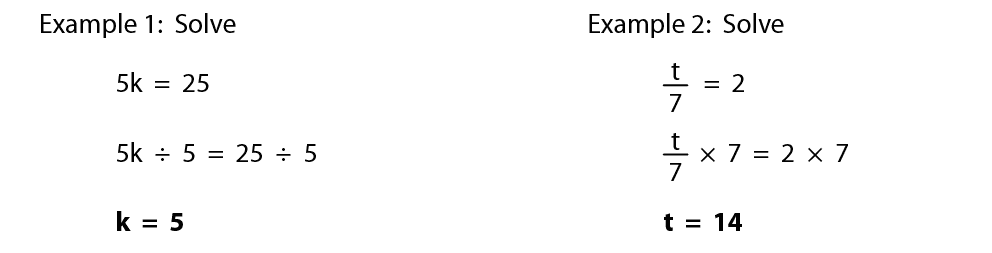
Home Algebra Equations One Step Equation One Step Equation Worksheets One step equation worksheets for grades 6 to 8 are perfect for introducing students to basic algebra concepts. These worksheets focus on solving simple equations using a single operation—addition, subtraction, multiplication, or division. With easy-to-follow steps, students build confidence and master foundational algebra skills quickly. To start, learners understand that solving a one-step equation means performing the inverse operation to isolate the variable. For example, in the equation x – 4 = 9, students add 4 to both sides to find x = 13. If the equation is 5x = 20, they divide both sides by 5 to get x = 4. These worksheets include a wide range of problems suited for different levels within grades 6 to 8. Students practice with positive and negative numbers, as well as simple fractions and decimals. The worksheets gradually increase in difficulty to support skill development at each grade level. In addition, some worksheets include real-world word problems. These help students apply their math knowledge to everyday situations, like solving for costs, distances, or quantities. This reinforces the practical use of algebra. Teachers can use these worksheets in the classroom, for homework, or as review material. They are also great for test preparation and individual practice. Clear layouts and step-by-step instructions make them accessible for all learners. One Step Equation worksheets free download pdf Moreover, students learn to show their work, which strengthens their understanding and allows them to catch mistakes. This habit supports long-term success in more complex math topics. In conclusion, these worksheets for grades 6 to 8 offer essential practice for early algebra. With consistent use, students improve their problem-solving skills and prepare for advanced equations in higher grades.

Identifying Polynomials Worksheets

Home Algebra Identifying Polynomials Identifying Polynomials Worksheets Identifying polynomials worksheets for grades 7 to 9 help students learn how to recognize and classify polynomials based on their terms, degrees, and types. These worksheets introduce key concepts in algebra, such as monomials, binomials, and trinomials, making it easier for learners to identify different polynomial expressions. With practice, students improve their understanding of polynomials and their ability to classify algebraic expressions quickly. To begin, students learn that a polynomial is an algebraic expression consisting of terms connected by addition or subtraction. Each term has a coefficient and a variable raised to an exponent. Worksheets guide students to identify polynomials by counting the number of terms. For example, 3x + 5 is a binomial because it has two terms. 4x² – 2x + 1 is a trinomial because it has three terms. Next, students examine the degree of a polynomial. The degree is the highest power of the variable in the expression. For example, in 2x³ + 5x² – 3x + 7, the degree is 3 because the highest exponent is 3. Students practice identifying the degree of various polynomials in the worksheets. Additionally, students learn to recognize the type of polynomial. They classify polynomials as monomials (one term), binomials (two terms), or trinomials (three terms). Worksheets provide various examples, helping students distinguish between different types of polynomials based on their number of terms. Identifying Polynomials worksheets free download pdf In some worksheets, students are asked to simplify polynomials by combining like terms, further enhancing their understanding of polynomial structure. These exercises are ideal for reinforcing the concept and improving their algebraic skills. In conclusion, these worksheets for grades 7 to 9 are essential for mastering polynomial classification. With regular practice, students develop a stronger grasp of algebra and prepare for more advanced topics in mathematics.

Evaluate Algebraic Expressions

Home Algebra Evaluate Algebraic Identities Evaluating Algebraic Expressions Worksheets Evaluating algebraic expressions worksheets for grades 6 to 8 help students practice the essential skill of simplifying expressions by substituting values for variables. These worksheets guide students step by step through the process, reinforcing their understanding of algebra and helping them become more confident in solving expressions. With a variety of problems, students can improve their ability to evaluate expressions quickly and accurately. To begin, students first learn the basic structure of an algebraic expression. An expression consists of variables, constants, and mathematical operations. For example, in the expression 3x + 5, students substitute a value for x to simplify and find the result. These worksheets allow students to practice with different types of expressions, such as those involving addition, subtraction, multiplication, and division. Next, students learn to follow the order of operations (PEMDAS—Parentheses, Exponents, Multiplication and Division, Addition and Subtraction) when evaluating expressions. For example, in the expression 2 + 3(x – 4), students first simplify the terms inside the parentheses, then multiply, and finally add. This ensures they understand how to approach more complex expressions. The worksheets also include problems with both positive and negative numbers, fractions, and decimals, ensuring that students can handle various types of algebraic expressions. As the worksheets progress, they include multi-step problems that challenge students to apply their knowledge more effectively. Evaluate Algebraic Expressions worksheets free download pdf In addition, the worksheets often contain word problems that require students to translate real-life situations into algebraic expressions. This not only strengthens their algebraic skills but also shows the practical applications of math. In conclusion, these worksheets for grades 6 to 8 are an excellent way to practice and master algebra. These worksheets build critical skills that prepare students for more advanced math topics.

Understanding Algebraic Expressions

Home Algebra Algebraic Expressions Understanding Algebraic Expressions worksheets Understanding algebraic expressions worksheets for grades 6 to 8 help students grasp the fundamental building blocks of algebra. These worksheets introduce key terms like variables, coefficients, constants, and operators. With clear explanations and structured practice, students learn how to read, write, and interpret algebraic expressions confidently. To start, students explore what makes up an algebraic expression. They identify variables as letters that represent unknown values, while coefficients are the numbers multiplied by those variables. For example, in the expression 5x + 3, students recognize 5 as the coefficient, x as the variable, and 3 as the constant. Next, the worksheets guide students through combining like terms and simplifying expressions. This step is essential for developing fluency in algebra. Problems gradually increase in complexity, moving from basic expressions to multi-term expressions involving both addition and subtraction. Moreover, students learn to write expressions from word problems. This real-world connection helps them apply algebra in everyday scenarios, like calculating total cost or comparing quantities. These word problems encourage critical thinking and improve problem-solving skills. Download Free Algebraic Expressions Worksheets (PDF) The worksheets also include matching exercises, fill-in-the-blanks, and short-answer questions to reinforce concepts. These formats keep students engaged while strengthening their understanding of how expressions work. Teachers can use these resources in the classroom, for homework, or as review material. They are ideal for differentiated instruction and can be adjusted for learners at different skill levels within grades 6 to 8. In conclusion, these worksheets for grades 6 to 8 offer essential practice for young algebra learners. They help students develop a solid foundation in algebra by focusing on core concepts and gradual skill-building.

Scroll to Top